
In today’s rapidly digitising construction industry, Building Information Modelling (BIM) is more than a trending term; it’s the backbone of smarter, more collaborative project delivery. Yet, a common misconception among students and early-career professionals persists:
“BIM is the same everywhere.”
This couldn’t be further from the truth.
In reality, BIM standards vary significantly across countries, shaped by differing regulatory systems, construction practices, and client expectations. Whether you’re an aspiring architect, civil engineer, or MEP professional, understanding these regional BIM frameworks is essential if you aim to collaborate globally or pursue international opportunities.
At BIM Cafe Learning Hub, our philosophy is simple: Learn globally, apply locally. In this guide, we’ll walk you through the key BIM standards across the world, so you can build a future-proof career and contribute confidently to any project, anywhere.
What Are BIM Standards, and Why Do They Matter?
BIM is a collaborative digital process that integrates 3D models with vital project data, helping architects, engineers, and contractors plan, design, build, and manage assets more efficiently.
But how this process is structured, how data is created, shared, and validated, depends heavily on the BIM standards adopted in each region.
Think of BIM standards as the rules of the game. Without understanding the rules, collaboration becomes challenging, especially on large, cross-border projects where compliance is crucial.
Global Overview of BIM Standards
United States – LOD Framework (Level of Development)
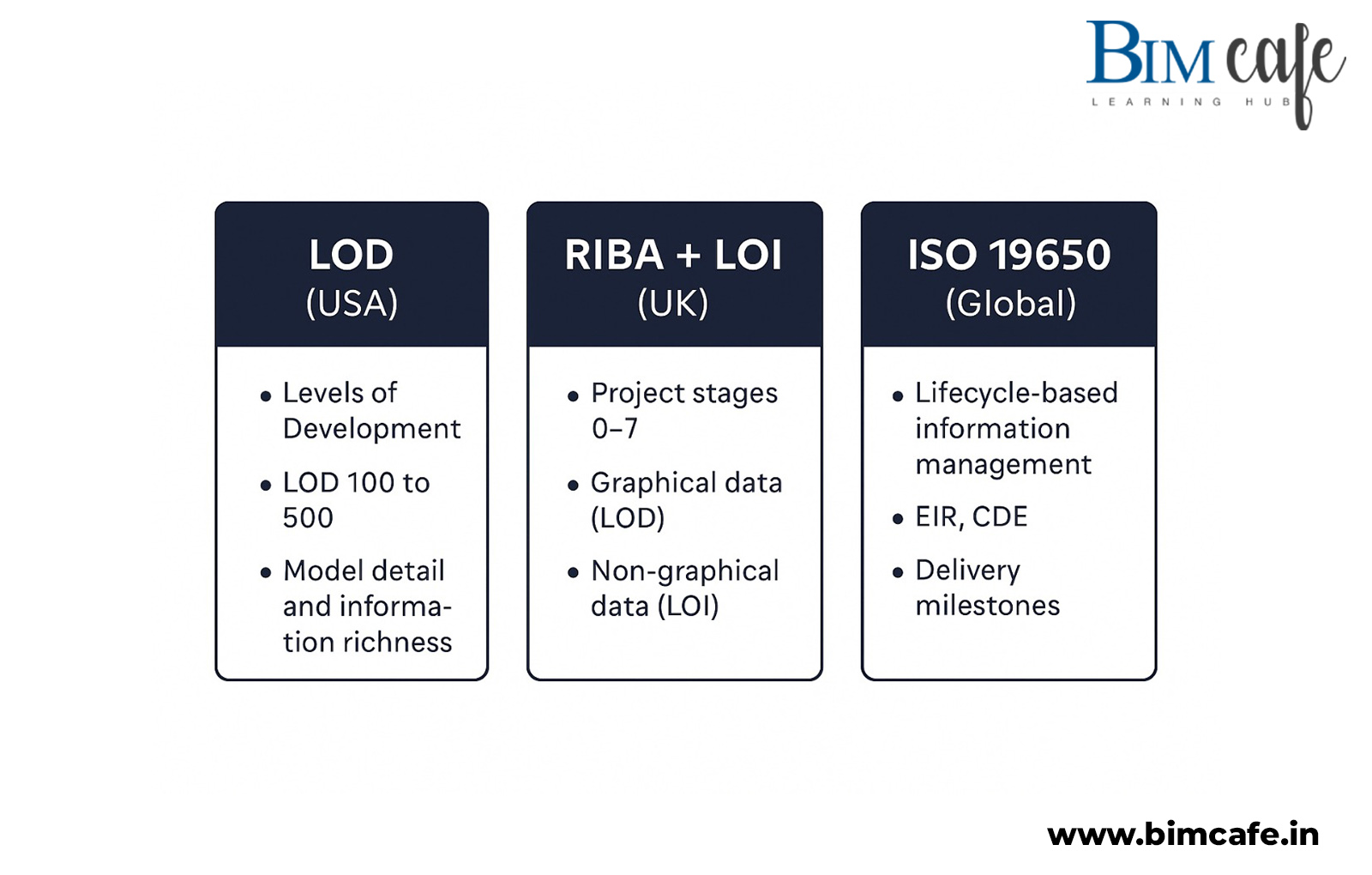
In the US, BIM is defined primarily by the LOD Specification, developed by the American Institute of Architects (AIA) and BIMForum.
Key Highlights:
- LOD stands for Level of Development, not just “detail”.
- Ranges from LOD 100 (Conceptual) to LOD 500 (As-Built).
- Each level defines both graphic detail and information richness.
- Commonly used in:
- Design-Build workflows
- Prefabrication and fabrication
- Facility management
- Design-Build workflows
Example:
An HVAC system at LOD 300 includes spatial coordination and dimensions, making it suitable for clash detection.
United Kingdom – RIBA Plan of Work + LOD/LOI
The UK’s BIM approach is admired for its structure and maturity, driven by the RIBA Plan of Work, which segments a project from Stage 0 (Strategic Definition) to Stage 7 (In Use).
In tandem, UK professionals use:
- LOD – graphical detail
- LOI – non-graphical information
While LOD/LOI doesn’t strictly follow the US LOD 100–500 scale, it plays a crucial role in defining model deliverables per project stage.
Evolution of Standards:
- Legacy: PAS 1192 and BS 1192
- Present: ISO 19650 adoption across the UK
- RIBA Stages still form the project backbone
ISO 19650 – The Global BIM Framework
To harmonize BIM practices internationally, ISO 19650 was introduced, rooted in the UK’s PAS 1192 and now used in many countries, including India, the UAE, Australia, and South Africa.
Key Features:
- Focuses on information management across a project lifecycle
- Introduces essential terms like:
- EIR (Exchange Information Requirements)
- CDE (Common Data Environment)
- Information Delivery Milestones
- EIR (Exchange Information Requirements)
- Allows customised LOD systems per project/client needs
Why It Matters:
ISO 19650 provides a scalable and flexible BIM environment, especially valuable for large, multinational project teams.
Country-Specific BIM Frameworks
India
- BIM adoption is rapidly growing.
- CPWD and NICSI refer to ISO 19650 in guidelines.
- Government tenders increasingly require BIM deliverables.
United Arab Emirates
- Authorities like Dubai Municipality have issued BIM mandates.
- US-style LOD terminology is used, but not always strictly.
- BIM is often compulsory in infrastructure and mega projects.
Singapore
- BCA (Building and Construction Authority) mandates BIM submissions.
- Under CORENET X, BIM is tied to digital regulatory approvals.
- Strong focus on automated model validation.
Germany
- Uses VDI 2552 BIM guideline series.
- Prioritises IFC (Industry Foundation Classes) for interoperability.
- Government-led BIM adoption via Planen-Bauen 4.0.
Australia & New Zealand
- Public projects align with ISO 19650.
- Each state/territory may have its own Digital Engineering (DE) framework.
- Emphasis on open standards and BEPs (BIM Execution Plans).
Why Should Students and Young Professionals Care?

As a BIM student or beginner, you might think these frameworks are something to worry about later. But that mindset limits your opportunities.
Here’s why understanding global BIM standards matters now:
1. Prepare for Global Careers
If you want to work in companies like AECOM, Atkins, Jacobs, or WSP, they follow project-specific standards depending on the region. Understanding the differences between RIBA, ISO, LOD, and LOI gives you a competitive edge.
2. Work with International Clients
Freelancers and consultants often deal with clients from the UAE, UK, or Australia. Adapting to their modeling expectations and documentation formats is key to retaining clients.
3. Excel in Collaborative Projects
Understanding standards like EIR, CDE, or IFC workflows helps you become a BIM Coordinator or Manager, not just a modeler.
4. Choose the Right BIM Training
All BIM courses aren’t created equal. At BIM Cafe Learning Hub, our curriculum aligns with international BIM frameworks, helping you learn globally relevant skills that employers seek.
Final Thoughts: Learn Globally, Apply Locally

There’s no such thing as a universal BIM language. Just like architecture styles vary from Tokyo to Toronto, BIM standards adapt to local needs and legal frameworks.
But by mastering the core principles behind ISO 19650, LOD, and RIBA, you’re not just learning BIM, you’re preparing for a borderless AEC career.
At BIM Cafe Learning Hub, we empower students and professionals to navigate the global BIM landscape with confidence. With certified trainers, project-based learning, and placement assurance, we’re not just teaching software; we’re building your BIM career.
Ready to future-proof your AEC career? Enrol now at BIM Cafe Learning Hub and start mastering globally recognised BIM standards today.